
The objective was to use AI for sea ice chart production.
The competition was sponsored by the ESA Phi-Lab.
Machine learning computing resources were made available to challenge participants on Polar TEP.
42 teams used Polar TEP ML resources, accumulating 3,912 hours of processing time.
Six of the top ten teams used Polar TEP.
The winning team was from the University of Waterloo.
Foundation models (FMs) use self-supervised learning (SSL) on massive unlabeled datasets.
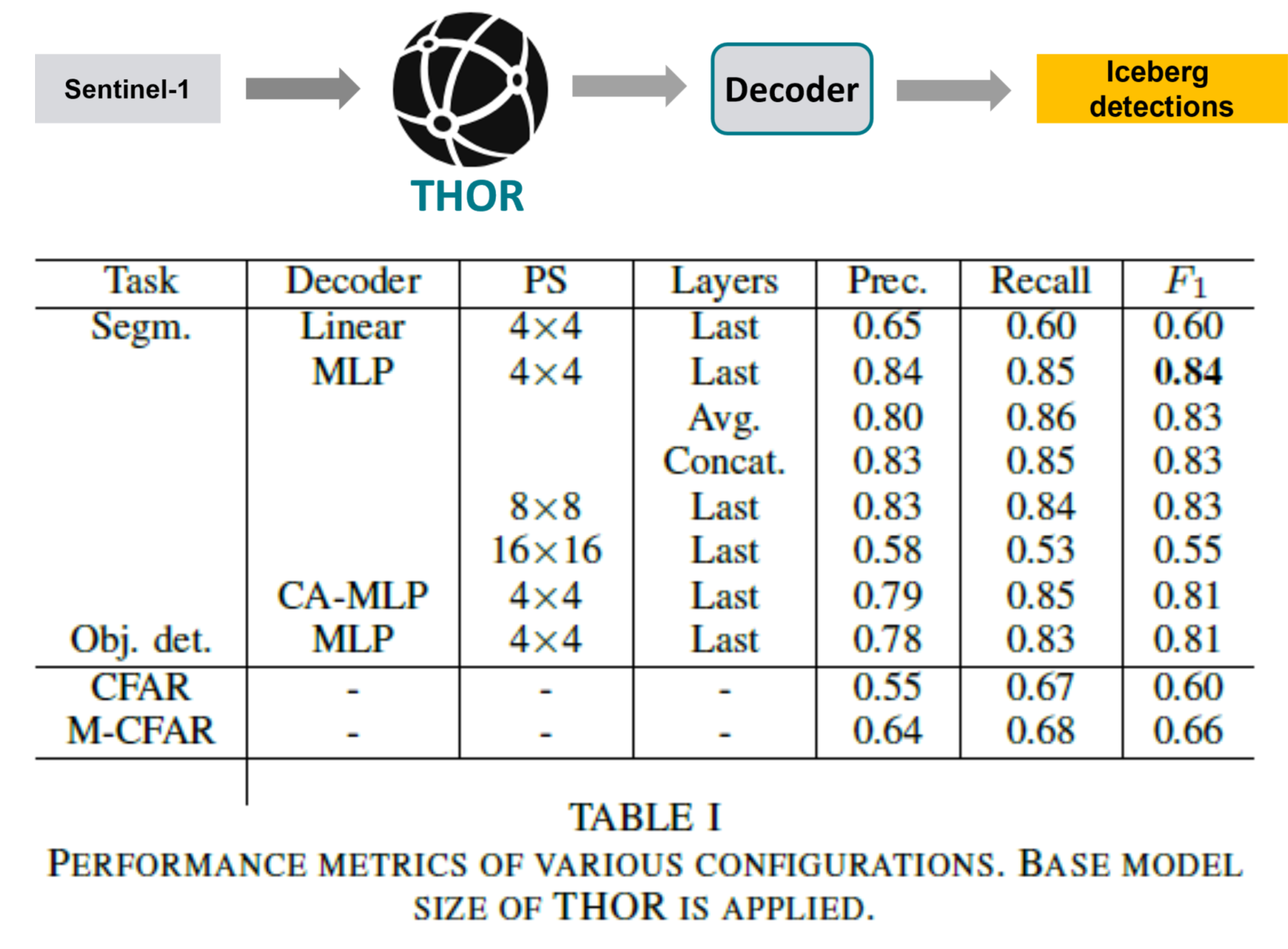
THOR is a FM, developed by the Norwegian Computing Center, that was pre-trained on 20TB of satellite data using the LUMI supercomputer.
For iceberg detection, THOR processes Sentinel-1 GRD images using a small patch size (e.g., 4×4) to generate dense feature maps, which are then passed to lightweight decoder (e.g., Linear, MLP, or CA-MLP).
Advantages:
- Computational efficiency and speed
- Performance in sea clutter
- Small object detection
THOR will be available for use and development in Polar TEP.